

Heroes Teach Us How to Process Hurt
Aaron Welty on the curious, sarcastic messaging of "Supergirl"
This is a guest post by Aaron Welty
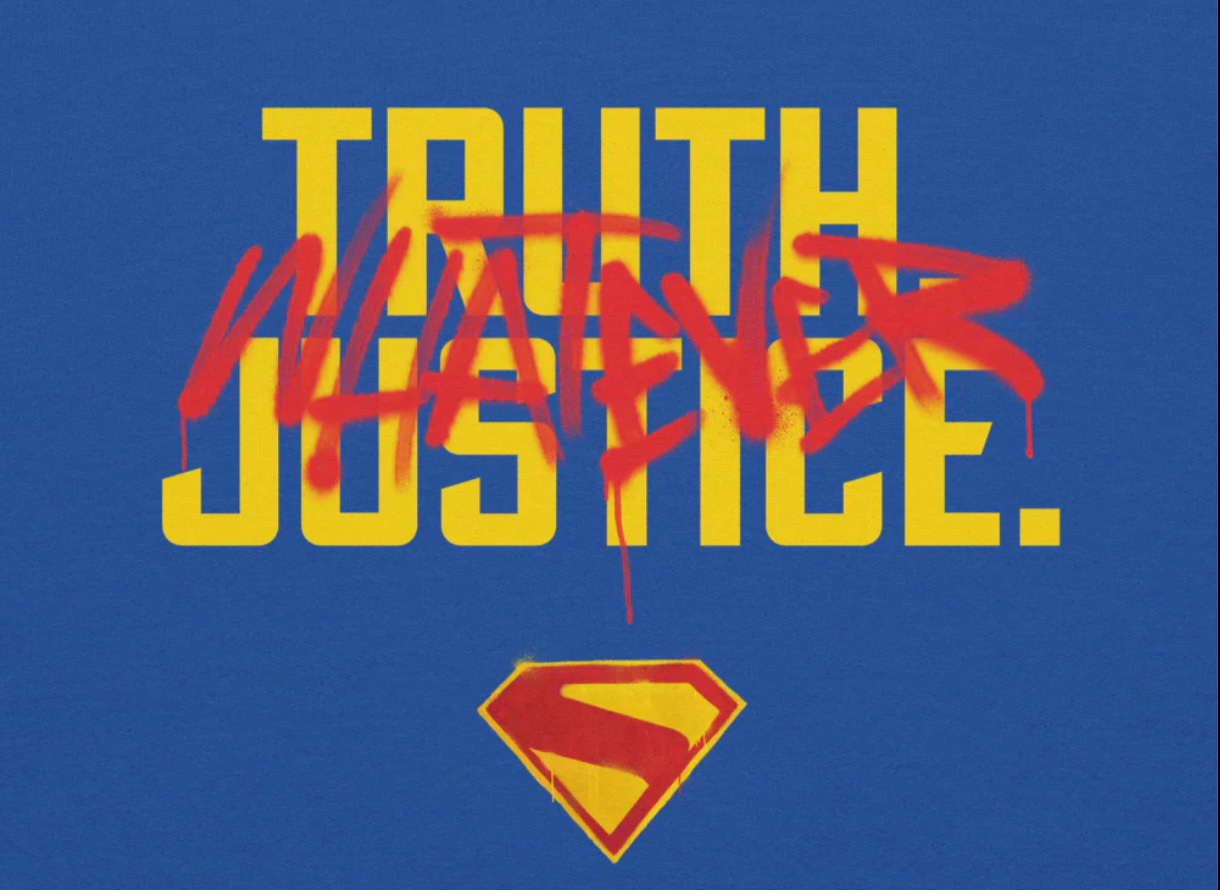
Truth. Justice. Whatever. Exclamations on a theatrical poster for Supergirl, out in June from DC Studios. It feels different from previous silver-screen and small-screen iterations of the titular character, such as the 1984 film, the Arrowverse show, or various animated versions. In these, the Maiden of Might earnestly upheld Truth, Justice, and the hopeful/heroic way of the House of EL. Instead of those values, the new Supergirl may choose vengeance and violence instead.
The upcoming Supergirl film is rooted in Tom King’s celebrated Supergirl: Woman of Tomorrow graphic novel, released in 2021. The story finds Kara Zor-El (played by Milly Alcock in the upcoming film), Superman’s cousin, far from Earth. Instead of her adopted home, she’s celebrating her birthday on another planet. During a drunken bar fight—which feels like Mos Eisley Cantina meets Roadhouse—she meets a local girl, Ruthye (Eve Ridley), bent on avenging her late father’s death. Ruthye needs Kara’s help to find her father’s killer, Krem of the Yellow Hills (Matthias Schoenearts). What follows is the story of an intergalactic road trip in which this young female protagonist embarks on an adventure with the Maiden of Might as they traverse the cosmos to deliver justice for her father’s killer. While likely being pursued by Lobo, an intergalactic bounty hunter (a role Jason Momoa looks born to play).
The graphic novel is a wonderful read, beautifully illustrated, and completely engrossing; like you’re on this cosmic quest with the characters. Not unlike Bastion in The Neverending Story. It puts the protagonists in pressing places where they struggle with their circumstances and the ensuing grief - Ruthye at the loss of her father and what her grief threatens to make her, and Kara at the loss of her native Krypton. Both have lost their families, and as such, their worlds. Kara does what she can to control and contain her heartbreak because she doesn’t want to see her young charge become what they both so easily could: victims who weaponize their wounds to create more victims like themselves.
This is how villainy can happen, when past pain can’t be put in its proper place.
Instead, Supergirl: Woman of Tomorrow builds itself up as a journey of formation and realization, of heroic forging. A story of processing and (hopefully) purging painful pasts and moving from groaning to growing. Until it doesn’t. All along, it’s asking the questions in the background: what do we do with our pain? Does our victimization push us towards becoming virtuous victors or vile villains?
Does our hurt propel us towards heroism and healthy coping, thus allowing us to help others heal and pass on to them a hope of brighter days ahead? Or do we weaponize our wounds to create more victims like ourselves?

And just when the protagonists are pushed to the brink, when that question of justice versus vengeful violence is staring out from the panel and page, the story steps back from the edge. Until the final pages find Ruthye and Kara together again, 300 years later.
300 years later, Ruthye is an old woman with a secret. 300 years later, Kara releases a repentant Krem, a reformed killer, from The Phantom Zone. He’s spent all these years seeking redemption, restoration, and restitution; in a word, seeking forgiveness for what he’d done to so many. And so, he comes to Ruthye, begging forgiveness. And she does not give it. That’s her secret - she’s harbored hate for him for centuries. Instead, in the final panels, on the last page, she murders Krem, while Supergirl watches.
What begins as a tale of grief turned growth concludes as a warning against hoping too highly in our hero’s hearts. For if this story is to be followed closely in its silver-screen salute, the film may end in vengeful murder because Ruthye couldn’t forgive. In King’s take, she exacted revenge, wanting Krem to feel what her father felt. And it could happen again, for a far larger audience.
This summer, with Truth, Justice, and the fate of a repentant soul on the line, questions will be answered, and Gunn’s version of Krypton’s last daughter might respond with, “whatever.”
With restitution, redemption, and restoration on the line, our heroes fail. Utterly, heartbreakingly, and shockingly. Like Frodo, they succumb. Unlike The Return of the King, though, this failure is the resolution. The conclusion is shocking and might be how the upcoming Supergirl film ends as well—the portrayal of the title character for the new film certainly projects a callous and irreverent attitude in trailers and TV spots.
And perhaps that’s the lesson, that evil sometimes gains the upper hand when heroes can’t overcome the hurt in their own hearts because some things seemingly can’t be forgiven. As traditionally attributed to Edmund Burke, “all that is necessary for evil to triumph is for good men to do nothing,” and in this case, the good woman does nothing. Supergirl stands by while a murder is committed because her own pain seemed to get the better of her (and certainly Ruthye). When Superman takes Zod’s life in Man of Steel, it’s something he’s clearly aggrieved by, something he only does because of the actual danger Zod poses towards innocent bystanders. Kal-El’s ensuing grief and regret are palpable. Kara’s pain seems to have made her indifferent toward Krem’s death.
Heroes harness their hurt to help others heal, something Supergirl seems to be doing in this story, until she doesn’t, because she’s still hurting from Kryton’s destruction (and deeply so). Villains weaponize their wounds to create more victims like themselves (something Ruthye falls prey to). Thus, Supergirl: Woman of Tomorrow leaves the reader to wrestle with deep questions. Not just “what would I do if it were me?” Would I succumb as the villain does? Would I overcome like the hero? These panels on the final page are asking a deeper, more daring question: do I have it within me to succeed where these heroes fail? To show grace, restraint, and redemptive reconciliation when what I really want to do is unleash self-righteous wrath?
And yet, if we can’t expect better from our heroic modern myths, how can we expect better of ourselves if they’re supposed to be examples of what we aspire to? James Gunn was able to answer this in a satisfying way with Rocket Raccoon in Guardians of the Galaxy—when the High Evolutionary didn’t die at his paw. Will these final images on the panel and page translate to the silver screen? Will these characters take a villainous turn and, in so doing, justify the murder of a penitent man?
This summer, with Truth, Justice, and the fate of a repentant soul on the line, questions will be answered, and Gunn’s version of Krypton’s last daughter might respond with, “whatever”.